

Botanical supplements continue to be one of the fastest-growing areas of the dietary supplement industry. From ashwagandha and turmeric to beet root and elderberry, consumers are turning to plant-based ingredients for everyday wellness support.
For supplement brands, this growth creates opportunities to develop new products, explore trending ingredients, and reach a wider customer base. Understanding the latest botanical supplement market statistics and consumer purchasing trends can help businesses identify promising ingredients and make informed product development decisions.
A Growing Market for Botanical Supplements
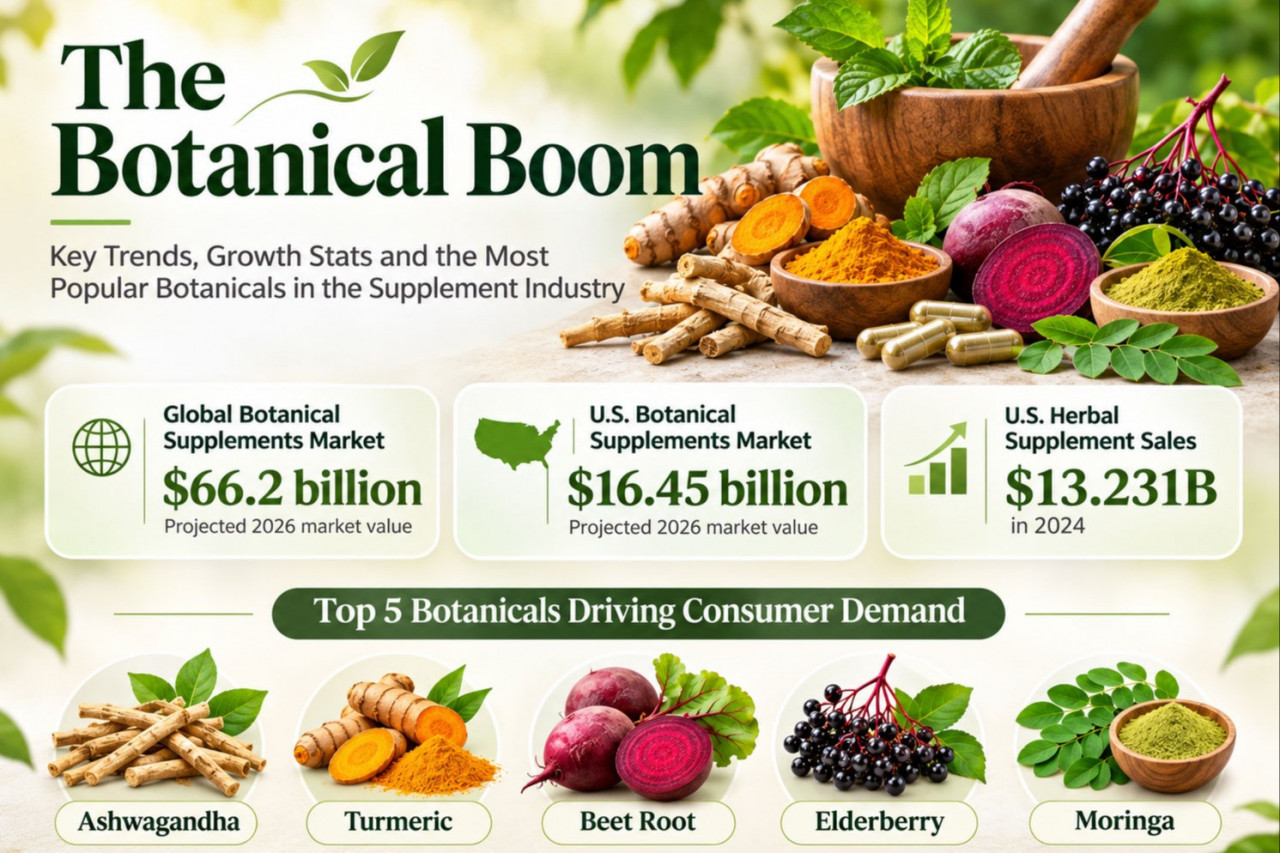
The global botanical supplements market is projected to reach $66.2 billion in 2026, up from $60.02 billion in 2025. This represents approximately 10.3% growth in just one year.
According to Fortune Business Insights, the global market is forecast to climb to $143.44 billion by 2034, demonstrating strong long-term potential for plant-based supplement products.
The United States is also experiencing notable growth. The U.S. botanical supplements market is expected to increase from $15.36 billion in 2025 to $16.45 billion in 2026, representing a 7.1% increase. Mordor Intelligence projects that the U.S. market will reach $23.2 billion by 2031.
These projections reflect growing consumer interest in botanical ingredients and the opportunities available to supplement brands looking to introduce innovative, high-quality products.
Botanical Supplement Market Statistics at a Glance
| Market | Projected 2026 Value | Growth From 2025 |
|---|---|---|
| Global Botanical Supplements | $66.2 billion | 10.3% |
| U.S. Botanical Supplements | $16.45 billion | 7.1% |
Sources: Fortune Business Insights and Mordor Intelligence.
U.S. Herbal Supplement Sales Reach a New High
The botanical supplement industry's expansion is supported by record herbal supplement sales in the United States.
According to the American Botanical Council, Nutrition Business Journal, and SPINS, U.S. herbal dietary supplement sales reached $13.231 billion in 2024, an increase of 5.4% over 2023.
Annual retail sales across channels demonstrate the continued growth:
2023: $12.551 billion
2024: $13.231 billion
Year-over-year growth: 5.4%
These figures highlight the continued popularity of herbal supplements among American consumers. With billions of dollars in annual retail sales, botanicals represent an established and growing category within the broader dietary supplement industry.
Source: American Botanical Council, Nutrition Business Journal, and SPINS.
Single Ingredients Lead, but Combination Formulas Are Rising
Single-ingredient botanical supplements continue to command a significant portion of the market.
In 2025, single-botanical supplements accounted for 51.58% of the U.S. botanical market, reflecting consumer interest in products featuring clearly identified ingredients.
However, combination botanical supplements are also gaining momentum.
The combination botanical supplement segment is projected to grow at a compound annual growth rate (CAGR) of 8.63%, creating opportunities for brands interested in developing blends that address specific wellness goals.
Single-ingredient products can appeal to consumers seeking a particular botanical, while multi-ingredient formulations allow supplement companies to combine complementary ingredients into differentiated products.
For brands evaluating their next product launch, both approaches offer opportunities to serve different consumer preferences.
Source: Mordor Intelligence.
Top 5 Botanicals Driving Consumer Demand
Retail sales and growth figures from 2024 highlight several botanicals attracting substantial consumer interest.
While past performance does not guarantee future results, these trends can help supplement brands identify popular ingredients and explore emerging product opportunities.
1. Ashwagandha
$165.7 Million in 2024 Retail Sales
Ashwagandha remains one of the most popular botanical ingredients in the supplement market, particularly among consumers interested in stress management, relaxation, and sleep support.
In 2024, ashwagandha generated approximately $165.7 million in combined mainstream and natural retail sales.
The ingredient also recorded growth across both retail channels:
Mainstream channel sales increased 13.8%.
Natural channel sales increased 6%.
Ashwagandha's continued growth reflects strong consumer interest in adaptogenic botanicals and products positioned around everyday wellness.
For supplement brands, ashwagandha offers opportunities for both standalone products and combination formulations designed around relaxation, stress support, and sleep-related wellness.
2. Turmeric
$141.8 Million in 2024 Mainstream Retail Sales
Turmeric has maintained a strong presence in the dietary supplement market, supported by consumer familiarity with the ingredient and its naturally occurring curcuminoids.
In 2024, turmeric generated approximately $141.8 million in mainstream retail sales.
Although mainstream sales declined 2.9%, turmeric also generated $37.1 million in natural retail channel sales, demonstrating its continued relevance across different consumer markets.
Turmeric is widely associated with antioxidant support and the maintenance of a healthy inflammatory response.
For supplement brands, turmeric remains an established botanical ingredient worth considering for standalone formulations or blends containing complementary ingredients.
3. Beet Root
+67.7% Mainstream Retail Sales Growth in 2024
Beet root stood out as one of the fastest-growing botanicals highlighted in the 2024 retail data.
The ingredient generated approximately $117 million in mainstream retail sales, representing an impressive 67.7% increase.
This growth makes beet root particularly interesting for supplement brands evaluating ingredients with increasing consumer demand.
Beet root contains naturally occurring dietary nitrates and is commonly associated with products focused on exercise performance, circulation, and nitric oxide support.
Its strong sales growth suggests opportunities for brands interested in botanical products targeting active consumers and general wellness audiences.
4. Elderberry
$145.2 Million in 2024 Mainstream Retail Sales
Elderberry remains a recognizable botanical ingredient, particularly within the immune support category.
In 2024, elderberry generated approximately $145.2 million in mainstream retail sales.
However, sales declined approximately 21% year over year, demonstrating that even established botanical categories can experience significant changes in consumer demand.
Despite the decline, elderberry maintained substantial retail sales, highlighting its established position in the herbal supplement marketplace.
For brands considering elderberry products, these figures illustrate the importance of evaluating both overall market size and recent sales performance rather than relying solely on an ingredient's popularity.
5. Moringa
+39.2% Natural Channel Retail Sales Growth in 2024
Moringa has emerged as another botanical ingredient attracting increased attention.
According to the 2024 retail data, moringa experienced 39.2% growth in natural channel sales, placing it among the faster-growing herbal ingredients highlighted in the report.
Moringa is a plant traditionally used as a food and botanical ingredient. Its leaves naturally contain various nutrients and plant compounds, contributing to its appeal in plant-based wellness products.
The ingredient's recent growth may present opportunities for supplement brands interested in emerging botanicals and differentiated plant-based formulations.
Moringa's performance also demonstrates how ingredients gaining traction in natural retail channels can provide insight into developing consumer preferences.
What These Botanical Supplement Trends Mean for Brands
The statistics show that botanical supplements are more than a passing trend. They represent a significant and growing segment of the dietary supplement industry.
With strong consumer demand, established top-selling ingredients, and emerging botanicals gaining traction, brands of different sizes have opportunities to develop products that stand out in a competitive marketplace.
Several important trends emerge from the data.
Established botanicals continue to generate substantial sales. Ingredients such as ashwagandha, turmeric, and elderberry have demonstrated meaningful retail demand, even when individual categories experience fluctuations.
Emerging ingredients can create new product opportunities. The growth reported for beet root and moringa highlights how consumer interest can expand beyond traditionally popular botanical supplements.
Combination formulas offer another avenue for differentiation. While single-ingredient supplements maintain a substantial market share, projected growth in multi-botanical products creates opportunities for brands to explore complementary ingredient combinations.
Retail performance matters when selecting ingredients. Looking beyond an ingredient's popularity to examine actual sales, year-over-year growth, and channel performance can help brands make more informed product development decisions.
Ultimately, successful botanical supplement development requires more than identifying a trending ingredient. Product quality, formulation, manufacturing capabilities, and brand positioning all contribute to bringing a competitive supplement to market.
Bringing Botanical Supplement Products to Market
As interest in botanical supplements continues to expand, brands have opportunities to develop products featuring established ingredients as well as emerging botanicals.
Whether developing an ashwagandha supplement, a turmeric-based formula, or a multi-ingredient botanical blend, selecting the right manufacturing partner is an important part of the process.
Makers Nutrition provides herbal supplement manufacturing services for brands seeking to bring their products to market. With capabilities that support formulation, manufacturing, packaging, warehousing, and order fulfillment, Makers Nutrition can help businesses navigate the process of developing and launching dietary supplements.
For supplement brands exploring opportunities within the growing botanical market, understanding ingredient trends is an important first step toward creating products that align with consumer demand.
Interested in manufacturing a botanical supplement? Contact Makers Nutrition to discuss your formula, product requirements, and manufacturing options.
Market figures and ingredient sales statistics are based on the sources identified in the supplied infographic. Market projections are estimates and may change. Ingredient descriptions are provided for general informational purposes and are not intended as disease-treatment claims.